LeClaire Institute

Module 1 · Fats

The fat family tree first, then one fat molecule broken down step by step: 11 figures covering why fats and oils are the same thing, what a fat molecule is, the kinds of fatty acid, hydrogenation and body fat, how your body breaks a fat down for energy, where fats are used in the body, and finally a recap that puts it all together. The figure is on the left and the lesson script on the right; every script line has an ID like 3.2 (Figure 3, segment 2). Pink boxes show what each fat does in your body; the quiz is at the end.

Figures1234567891011
1
Figure 1

The fat family tree: the map of this lesson

partial hydrogenationFats9 kcal/gSaturatedno double bonds · solidUnsaturateddouble bonds · liquidTransstraightened · semi-solidMonounsaturated1 double bondPolyunsaturated2+ double bondsOmega-9oleic · body makes itOmega-3ALA · EPA · DHAOmega-6LA · GLA · AA
2
Figure 2

Fats and Oils Are the Same Thing

Same kind of molecule, different packing.

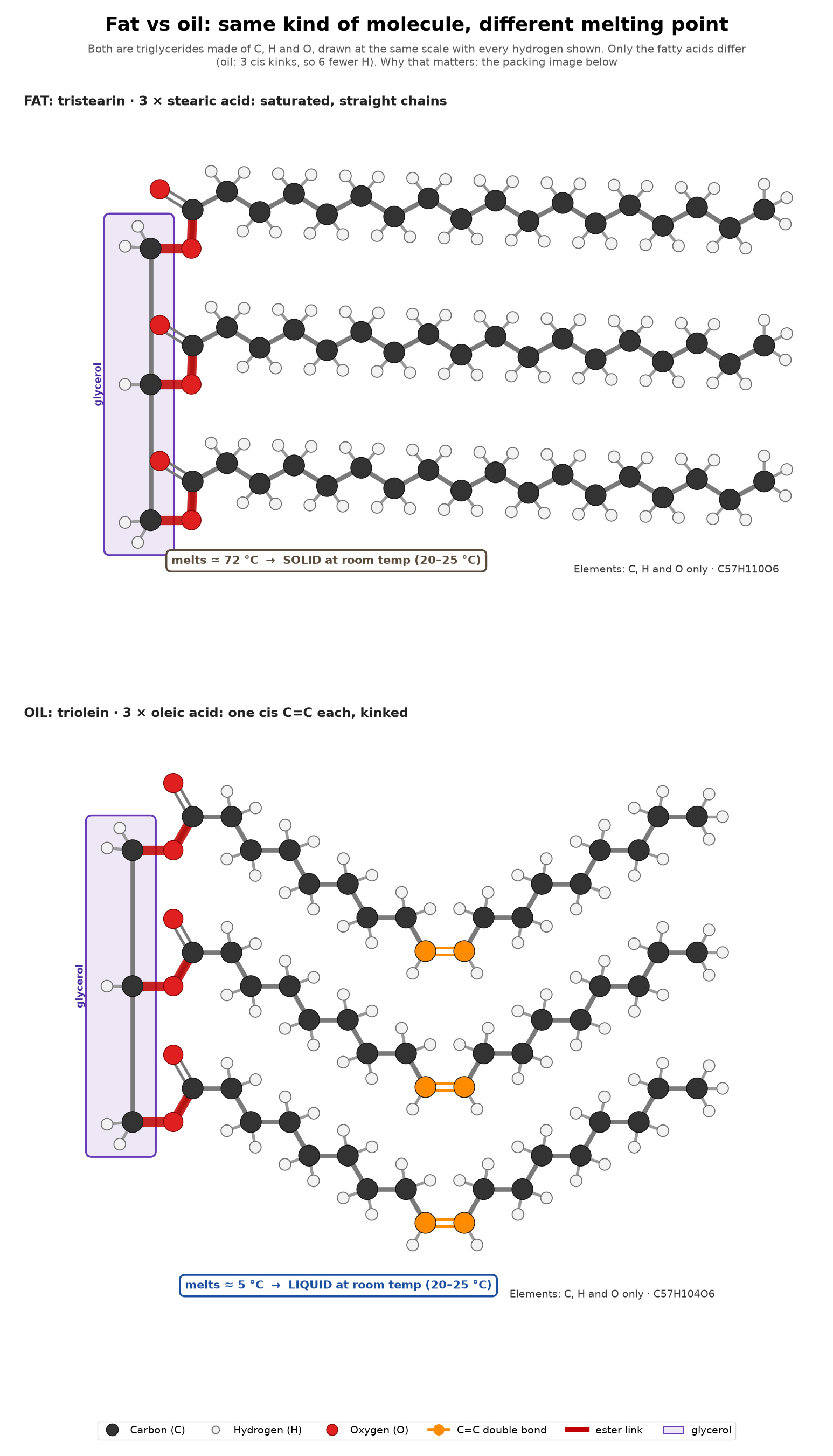
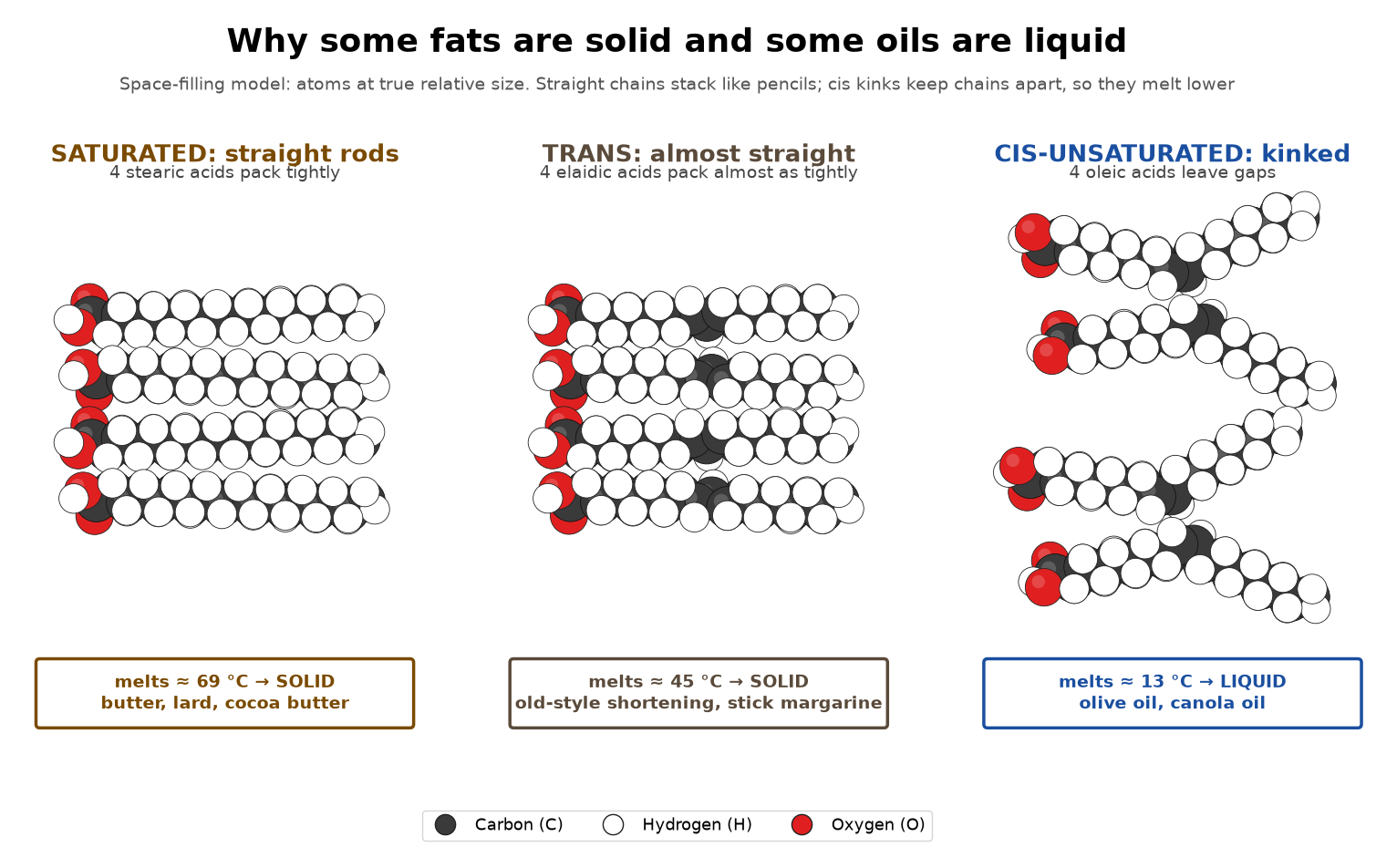
Figure 2: fat vs oil: tristearin above, triolein belowFigure 2: space-filling chains: saturated, trans and cis packing
Fat vs oil (top image): butter and olive oil are the same kind of molecule, made of the same elements (C, H, O). The difference is which fatty acids sit on the glycerol. Fats such as butter, lard and cocoa butter carry more saturated, straight chains; oils such as olive, canola and sunflower carry more cis double bonds, so kinked chains with slightly fewer hydrogens. That mix sets the melting point (pure tristearin melts at about 72 °C, pure triolein at about 5 °C). "Fat" or "oil" only names the state at room temperature (about 20–25 °C), not a different chemical class, and every real fat is a mix, so it is a matter of degree: coconut oil is mostly saturated and melts around 24 °C, so it is solid in a cool room and liquid in a warm one. Why the shape matters: the packing image below. Trans fats (Figure 4) are mostly man-made.

Packing (lower image): Drawn space-filling, at true atom sizes, each fatty acid is a solid rod. Straight saturated chains stack tightly like pencils in a box, so they hold on to each other and need more heat to melt: butter, lard and cocoa butter are solid at room temperature. Trans chains are almost straight, so they pack almost as tightly as saturated ones, which is why partially hydrogenated oil turns solid. Cis kinks keep chains from packing and leave gaps, so the chains slide past each other and melt below room temperature: olive and canola oil are liquid. In real fats the chains sit on triglycerides (Figure 3), and the same rule holds.
3
Figure 3

Fats: the molecule

Meet the atoms
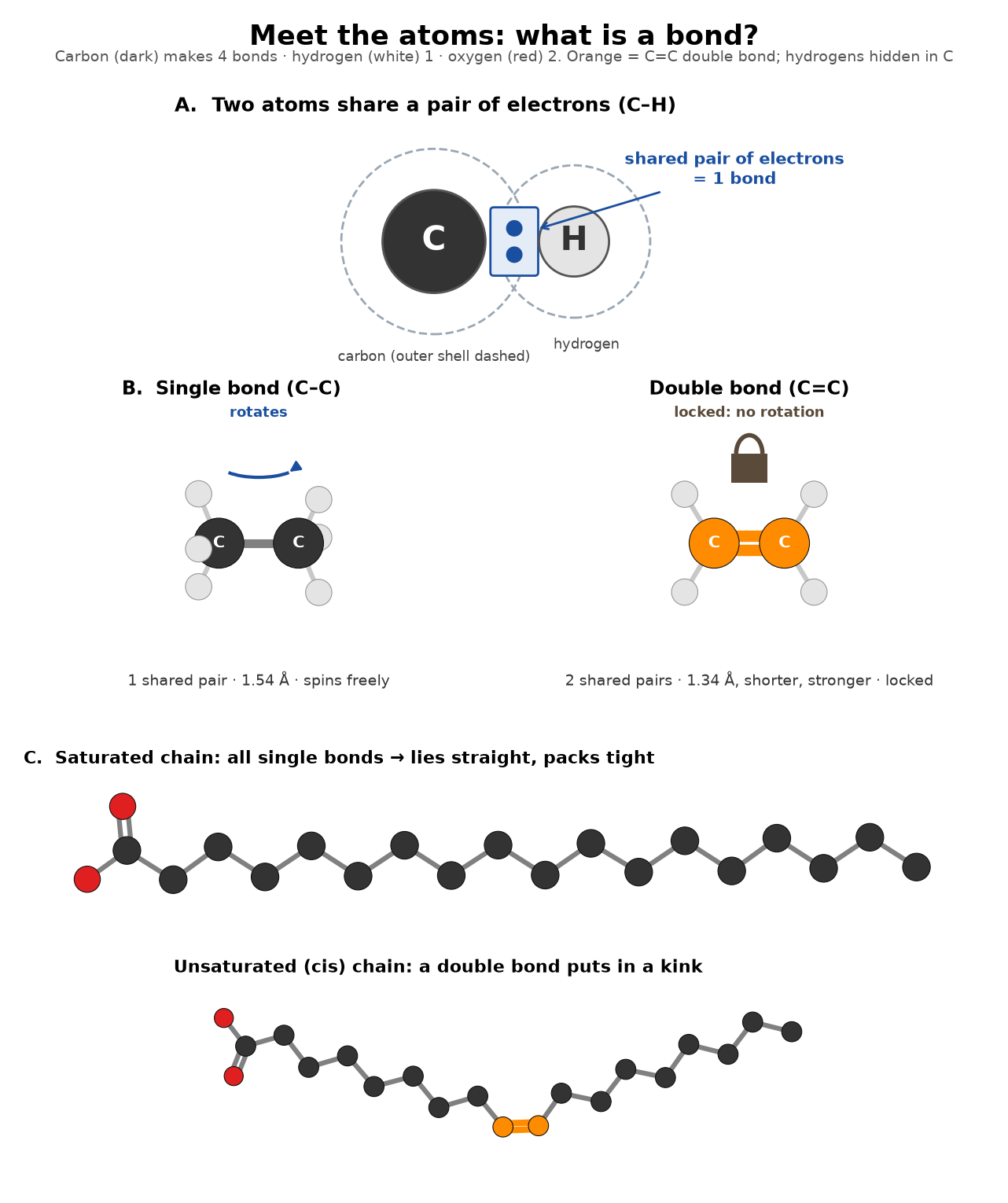
Figure 3: meet the atoms: what is a bond

What is a bond?

A bond is the attraction that holds two atoms together in a molecule. In the fats we're looking at, it's mostly carbon sharing electrons with hydrogen or with another carbon, and that sharing is what builds the chains.

How does that work exactly?

Atoms have electrons in shells around them, and atoms are happiest when their outer shell is full. A bond is when two atoms share a pair of those outer electrons so each one gets to count them. One shared pair is a single bond, which lets the atoms spin freely around each other. Two shared pairs is a double bond, which is shorter, stronger, and locks the atoms in place so they can't rotate. That's the whole trick behind saturated versus unsaturated fat: saturated chains are all single bonds, so they lie straight and pack tight. Unsaturated ones have double bonds that put a kink in the chain, and that's what keeps oils liquid.

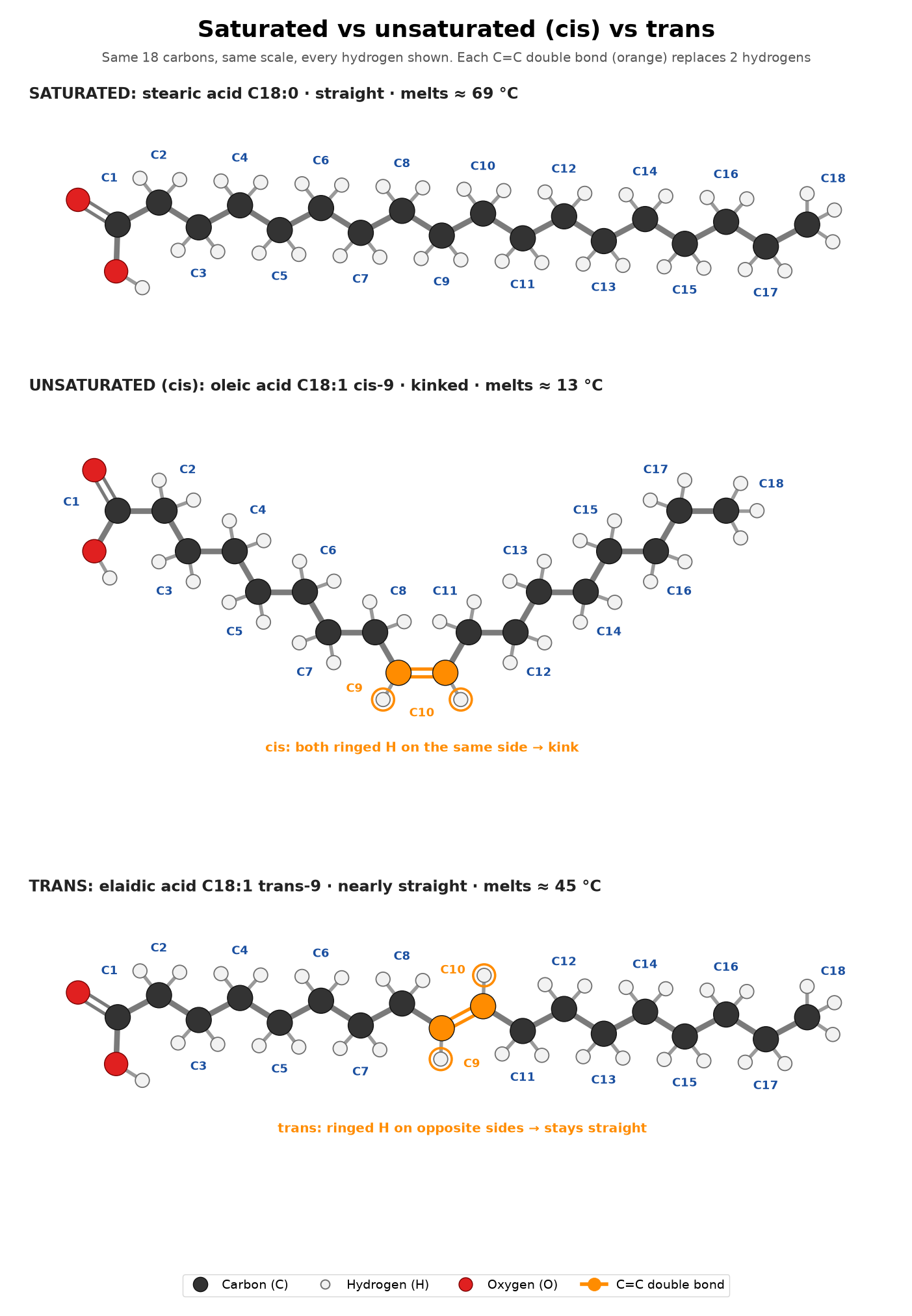
The kink comes from cis double bonds; trans double bonds stay nearly straight. See Figure 4.

The fat molecule
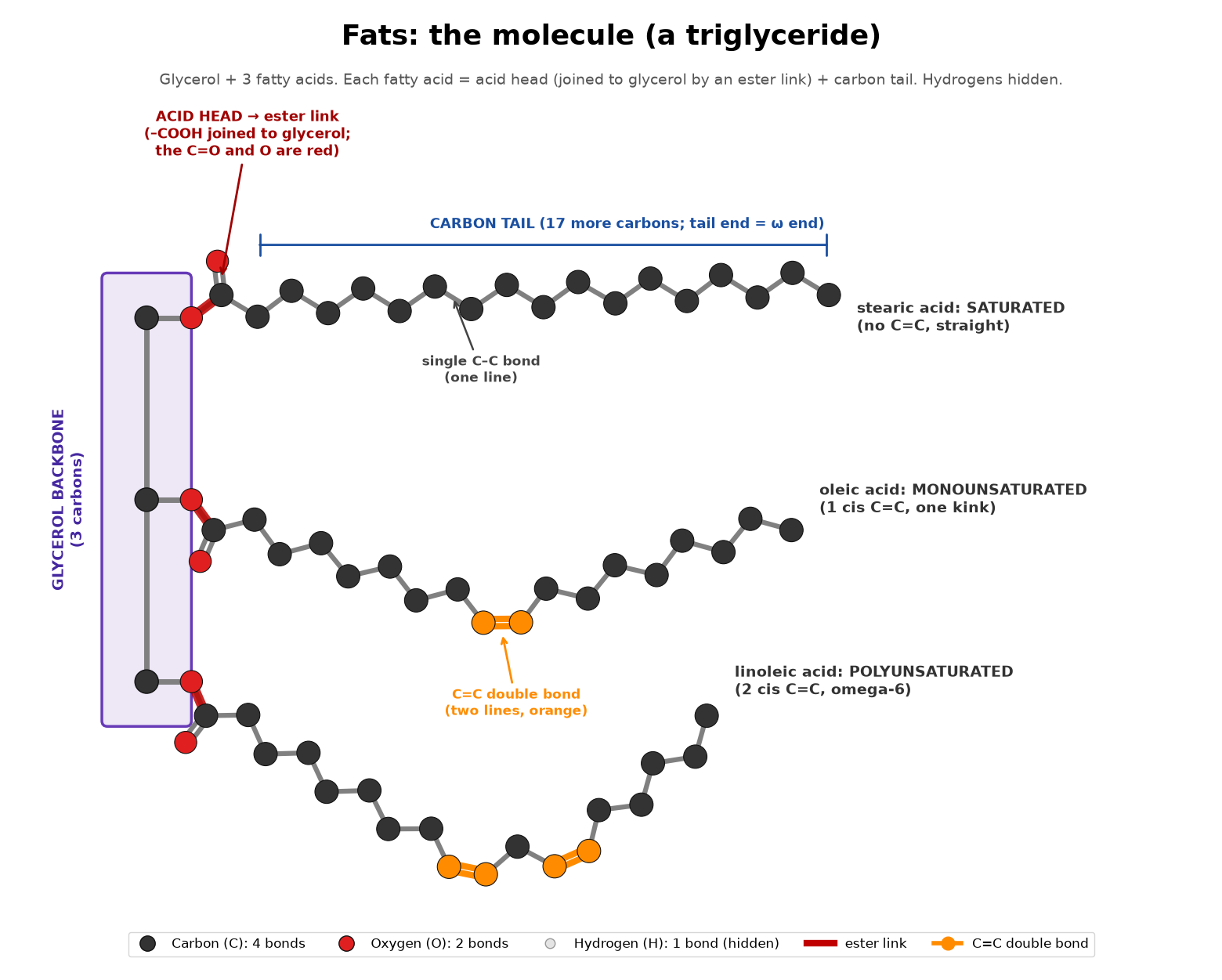
Figure 3: the triglyceride molecule
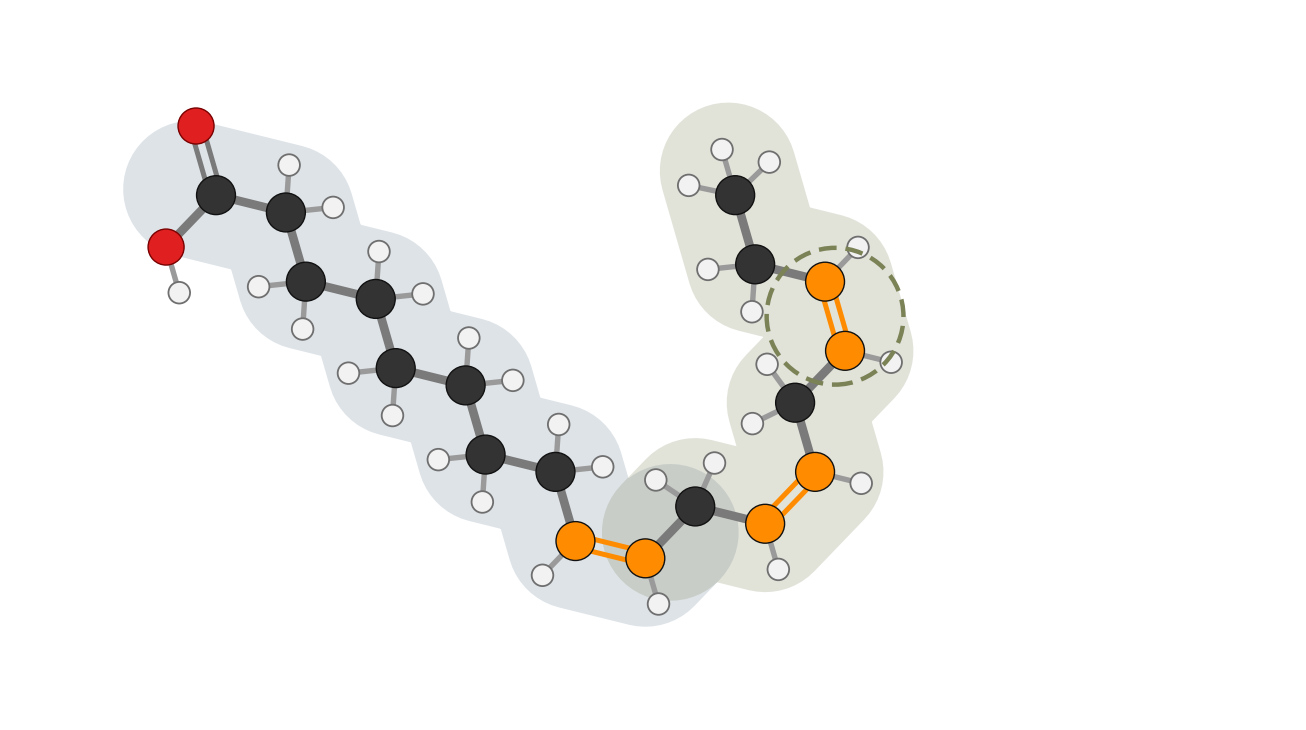
Almost all fat in food and in your body is a triglyceride: a glycerol backbone (3 carbons) holding 3 fatty acids. Each fatty acid has an acid head and a carbon tail. The acid head is a carboxyl group, –COOH (a carbon double-bonded to one oxygen and single-bonded to an O–H). It reacts with one of glycerol's –OH groups, giving off water, to form an ester link, which is what holds the fatty acid on the glycerol. The tail is a zigzag of carbons (bond angle about 109.5°), numbered from the head (C1); the far end is the omega (ω) end. Only three elements: carbon makes 4 bonds, oxygen 2, hydrogen 1. Tail carbons are joined by single C–C bonds (one line) or C=C double bonds (two lines, orange); a double-bonded carbon has room for fewer hydrogens. Every fat gives 9 kcal per gram (protein and carbs give 4). This lesson draws molecules as ball-and-stick models; textbooks often use skeletal line drawings, where each corner is a carbon and the hydrogens are left out.
4
Figure 4

Saturated vs unsaturated vs trans

Figure 4: Saturated vs unsaturated vs trans
The same 18-carbon chain three ways. Saturated (stearic acid, C18:0): no double bonds, so every tail carbon holds as many hydrogens as it can (two; the end carbon three) and the zigzag runs straight. It melts at about 69 °C, so stearic-rich fats like cocoa butter and beef fat are solid. Unsaturated, cis (oleic acid, C18:1 cis-9): a double bond between C9 and C10 takes the place of two hydrogens, which is what "unsaturated" means. Both remaining hydrogens sit on the same side, which bends the chain; it melts at about 13 °C, so olive oil is liquid. Trans (elaidic acid, C18:1 trans-9): the same double bond, but the hydrogens sit on opposite sides, so the chain stays nearly straight, packs like saturated fat and melts at about 45 °C. Plant oils and most natural fats are cis.
5
Figure 5

Monounsaturated vs polyunsaturated

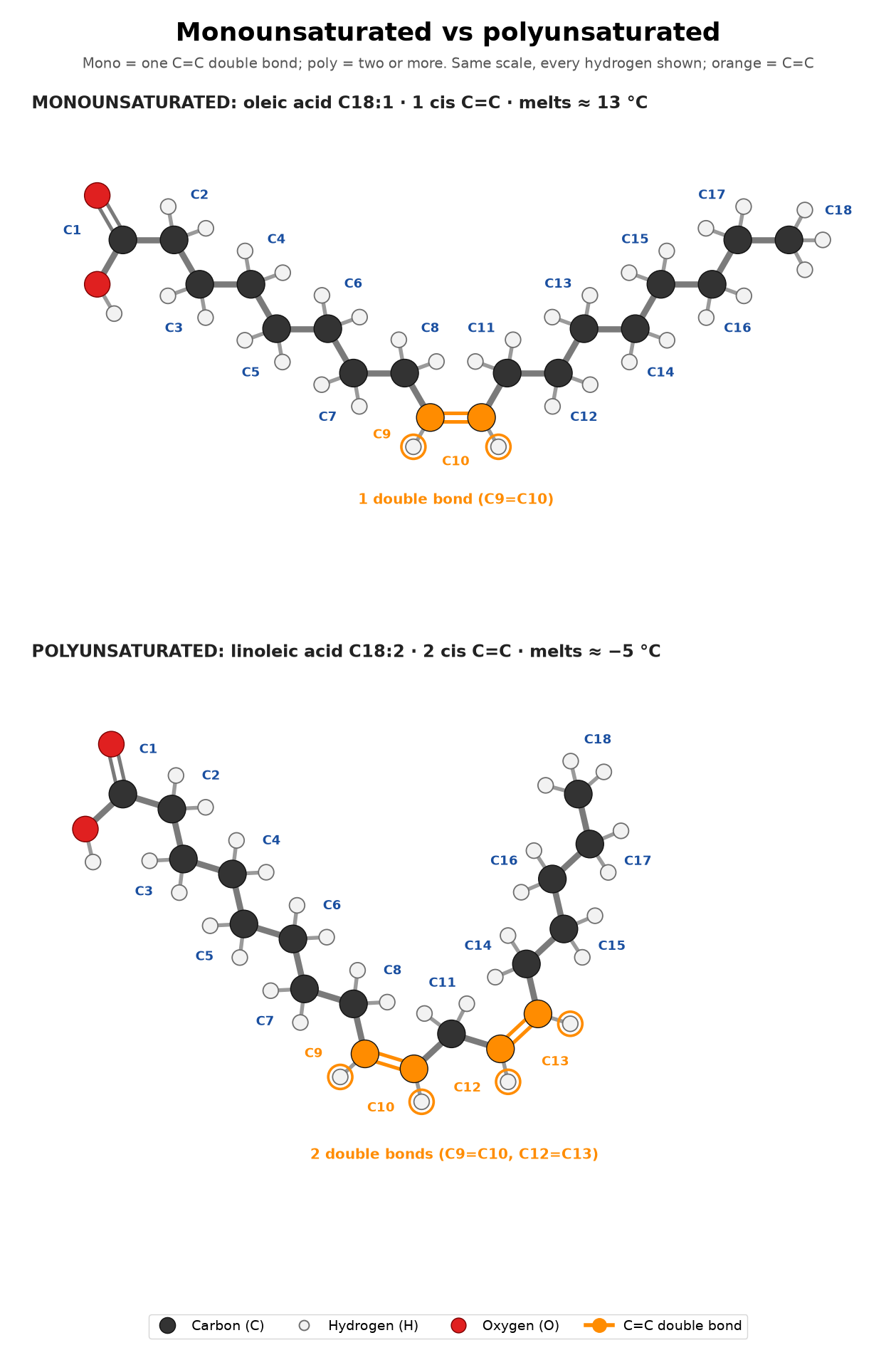
Figure 5: Monounsaturated vs polyunsaturated
Unsaturated fats are grouped by how many double bonds they have. Monounsaturated ("one"): oleic acid, C18:1, one cis double bond at C9=C10; the main fat in olive oil, and an omega-9 (Figure 6). Polyunsaturated ("many"): linoleic acid, C18:2, two cis double bonds at C9=C10 and C12=C13; found in sunflower, corn and other seed oils. Each extra cis kink lowers the melting point further: about 13 °C for oleic, about −5 °C for linoleic.
6
Figure 6

Omega-3, omega-6 and omega-9

Counted from the tail end; only omega-9 can be made by your body.

The omega-3 and omega-6 families, molecule by molecule

Every molecule is drawn at the same scale as the diagrams below, with every hydrogen shown. Blue numbers count from the acid end (orange = double-bond carbons); grey ω numbers count from the omega end. Tap a molecule to enlarge it.

Omega-3 row: ALA → EPA → DHA

Alpha-linolenic acid (ALA)18:3 omega-3 · 18 carbons, 3 cis double bonds, the first at ω3

C18H30O2. The plant omega-3, in flax, chia, walnuts and canola. Essential: you have to eat it.

↓Δ6 desaturase, elongase, Δ5 desaturase: 2 more carbons and 2 more double bonds, all added at the acid end.
Eicosapentaenoic acid (EPA)20:5 omega-3 · 20 carbons, 5 cis double bonds, the first still at ω3

C20H30O2. In oily fish and algae. Your body makes only a small amount from ALA.

↓Two elongations, a Δ6 desaturase, then one round of trimming: 2 more carbons and 1 more double bond, again at the acid end.
Docosahexaenoic acid (DHA)22:6 omega-3 · 22 carbons, 6 cis double bonds, the first still at ω3

C22H32O2. In oily fish and algae oil. A major building block of the brain and the retina; even less of it is made from ALA.

Omega-6 row: linoleic acid → arachidonic acid

Linoleic acid (LA)18:2 omega-6 · 18 carbons, 2 cis double bonds, the first at ω6

C18H32O2. The main omega-6 in sunflower, corn and soybean oil, nuts and poultry. Essential: you have to eat it.

↓Δ6 desaturase, elongase, Δ5 desaturase: the same enzymes as the omega-3 row, so 2 more carbons and 2 more double bonds at the acid end.
Arachidonic acid (AA)20:4 omega-6 · 20 carbons, 4 cis double bonds, the first still at ω6

C20H32O2. In meat and eggs, and made from linoleic acid. The starting point for omega-6 signals for immune responses, inflammation and blood clotting.

Each step keeps the omega end as it was, so an omega-3 stays an omega-3 and an omega-6 stays an omega-6. Pathways: Δ6 and Δ5 desaturases with elongases in the liver; the last step to DHA passes through a 24-carbon chain that is shortened by 2 carbons in peroxisomes.

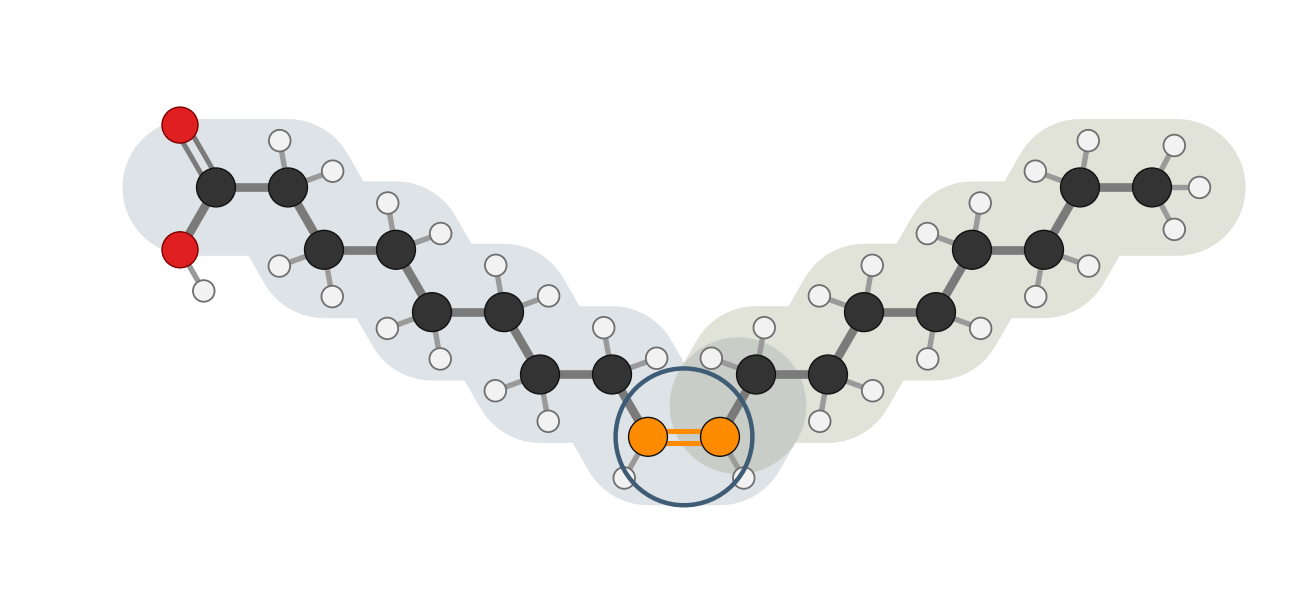
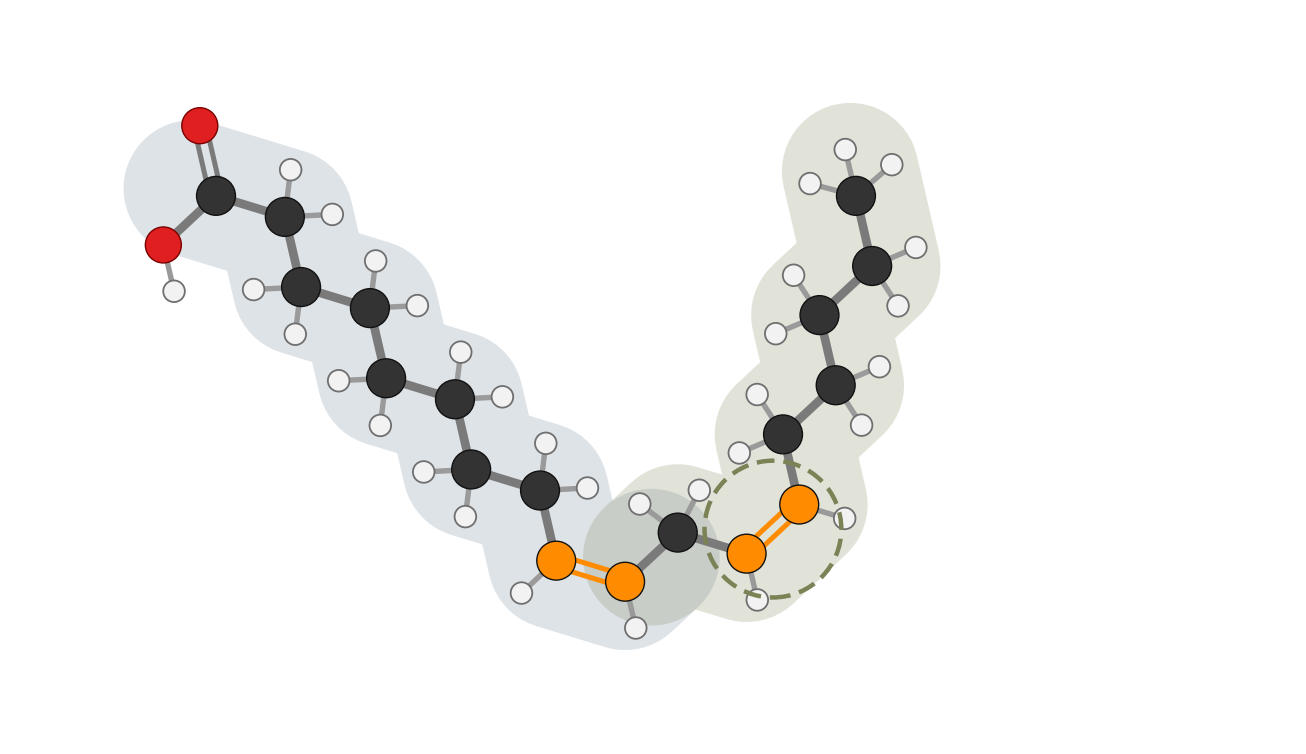
Unsaturated fats are named by counting from the tail (ω) end, where ω1 is the last carbon. ALA (C18:3, three cis double bonds; flax, chia, walnuts) has its first double bond at ω3, so it is an omega-3. Linoleic acid (C18:2, two cis double bonds; sunflower, corn and other seed oils) starts at ω6, so it is an omega-6. Oleic acid (C18:1; olive oil, avocados, almonds, macadamias), the main monounsaturated fat, has its one double bond at ω9, so it is an omega-9. The lower diagram shows why your body can make omega-9 but not omega-3 or omega-6.
Counting from both ends: what your enzymes can reach

Blue numbers count from the acid end (carbon 1 joins glycerol); grey ω numbers count from the omega end (shown at ω1, ω3, ω6 and ω9). The ringed double bond names the family.

Human enzymes reach double bonds at carbon 9 or closer to the acid end (Δ9)Plants and algae only carbon 12 (Δ12) and carbon 15 (Δ15)
Oleic acid · omega-9ω9 = carbon 9: inside reach, so your body makes it
Figure 6: Oleic acid · omega-9, carbons numbered from the acid end and from the omega end; ω9 = carbon 9: inside reach, so your body makes it2345678910ω9111213ω6141516ω317acid end
COOH
carbon 1
omega end
CH3
carbon 18 = ω1
Linoleic acid (LA) · omega-6ω6 = carbon 12: out of reach, so it is essential
Figure 6: Linoleic acid (LA) · omega-6, carbons numbered from the acid end and from the omega end; ω6 = carbon 12: out of reach, so it is essential2345678910ω9111213ω6141516ω317acid end
COOH
carbon 1
omega end
CH3
carbon 18 = ω1
Alpha-linolenic acid (ALA) · omega-3ω3 = carbon 15: out of reach, so it is essential
Figure 6: Alpha-linolenic acid (ALA) · omega-3, carbons numbered from the acid end and from the omega end; ω3 = carbon 15: out of reach, so it is essential2345678910ω9111213ω6141516ω317acid end
COOH
carbon 1
omega end
CH3
carbon 18 = ω1
  • Omega-9 is not essential. Adding one double bond at carbon 9 turns stearic acid into oleic acid, and that is within reach.
  • LA and ALA are essential. Humans lack the Δ12 and Δ15 desaturases; plants, algae and some microbes have them, and animals and fish get these fats from them.
  • Longer chains, edited at the acid end. LA → arachidonic acid; ALA → EPA → DHA, but only a small share of ALA becomes EPA and even less DHA, so fish and algae (EPA and DHA ready-made) matter.
  • No switching families. The omega end is never changed, so omega-6 and omega-3 can't be turned into each other: you need both.

Rule of thumb: your body can edit a chain near the acid end, but not near the omega end.

7
Figure 7

Hydrogenation: how oils become solid fats

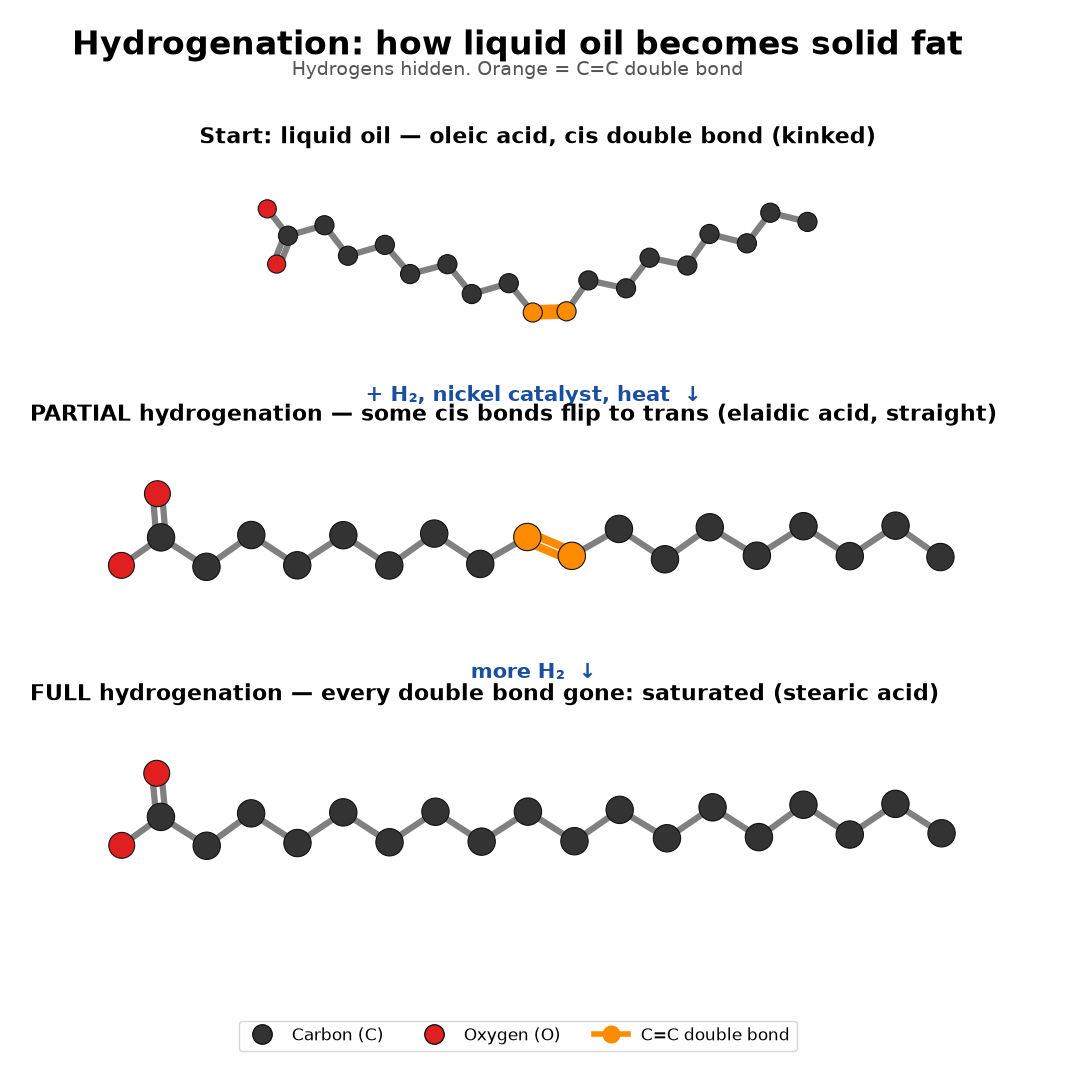
Figure 7: Hydrogenation: how oils become solid fats
Factories add hydrogen gas with a nickel catalyst and heat. Full hydrogenation removes every double bond and gives saturated fat. Partial hydrogenation stops partway: some double bonds remain and some flip from cis to trans, which is where most trans fat in food came from (Figure 4). Industrial trans fat is banned in the US and limited in the EU.
8
Figure 8

Melting points and body fat

room temp ≈ 20 °CStearic (saturated)69 °CElaidic (trans)45 °COleic (cis, mono)13 °CLinoleic (omega-6)-5 °CALA (omega-3)-11 °CSkin (cooler, ~32-34 °C)Outer fat layer: firmercooler, so the same fat is less fluidDeeper fat: softerat core body temperature (~37 °C)Muscle / organs (warm core)
Top: approximate melting points of the pure fatty acids; the dashed line is room temperature. Straighter chains (saturated, trans) melt higher, every cis kink lowers the melting point, and longer chains melt higher. Bottom: stored human fat is mostly triglycerides, and most of their fatty acids are unsaturated, with oleic acid the single most common, so it stays soft at body temperature (about 37 °C). Fat gets firmer as it cools, so it is firmer near the cooler skin and softer deeper in.
9
Figure 9

Breaking a fat down for energy

What a triglyceride is. One glycerol backbone joined to three fatty acids, which is where the “tri” comes from. It is the main form of fat in food and about 95% of the fat in your body, almost all of it stored in fat tissue. It is the molecule from Figure 3.

A. Many kinds of triglyceride

The glycerol backbone has 3 slots (1, 2, 3), and any fatty acid can sit in any slot. About 20 common fatty acids give 20 × 20 × 20 = 8,000 combinations.

Figure 9: A, many kinds: tristearin, three stearic acids (S S S) on glycerol slots 1 to 3Figure 9: triolein, three oleic acids (O O O), each with one cis kinkFigure 9: a mixed triglyceride: palmitic, oleic and linoleic (P O L), with legend

B. Breakdown and release

Low on energy (between meals, exercise, overnight): adrenaline and glucagon rise, insulin falls, and the fat-releasing lipases switch on.

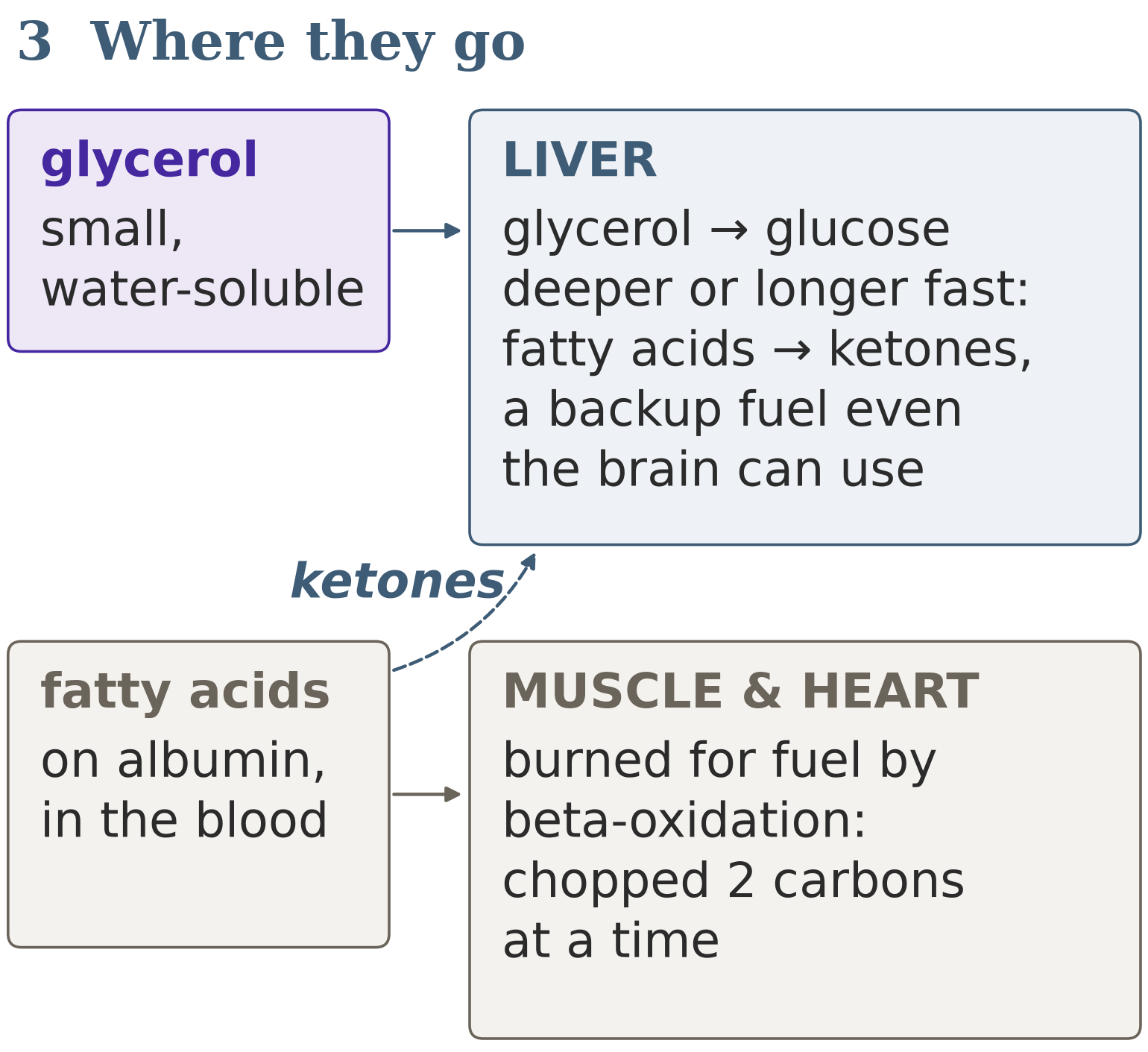
Figure 9: B, breakdown step 1: lipases cut the 3 ester links, adding waterFigure 9: step 2: 1 glycerol plus 3 free fatty acids carried on albumin in the bloodFigure 9: step 3: where they go, glycerol to the liver, fatty acids to muscle and heart
A, many kinds: the glycerol backbone has 3 slots and any fatty acid can sit in any of them, so with about 20 common fatty acids there are about 8,000 possible triglycerides: tristearin (S-S-S), triolein (O-O-O) and a mixed palmitic-oleic-linoleic one are three examples, and every food fat is a mix of many. B, breakdown: when energy is low, adrenaline and glucagon rise and insulin falls, switching on the lipases in fat tissue (ATGL, then HSL). They cut the 3 ester links, adding water at each, to release 1 glycerol and 3 free fatty acids. Glycerol goes to the liver, which can make glucose from it; the fatty acids ride on albumin in the blood to muscle and the heart and are burned for fuel by beta-oxidation, 2 carbons at a time. In a deeper fast the liver turns some into ketones. The energy is in the C–H bonds of the chain, which is why fat gives 9 kcal per gram.
10
Figure 10

Where fats are used in the body

Tap a number on the cell to see what that part does; the list below it gives every other place in the body.

Most fat you eat is stored; the rest is burned for fuel or built into cells.

Inside a cell

A typical animal cell, not to scale. Real cells hold thousands of ribosomes and hundreds of mitochondria.

Fat is the cell's fuel store and the raw material for its membranes.

  1. A double layer of phospholipids whose fatty-acid tails come partly from your diet; more unsaturated tails keep it more fluid.
  2. Stores fat as triglycerides; huge in fat cells, small in muscle and liver cells.
  3. Builds triglycerides and phospholipids from fatty acids and glycerol.
  4. Fatty acids are carried in by carnitine and cut two carbons at a time (beta-oxidation) to make ATP.
  5. Start breaking down very long fatty acids that mitochondria cannot handle.
  6. Enzymes here make new fatty acids from spare glucose when you eat more than you burn.

Everywhere else in the body

Each item, the places outside the cell where it is found or used, and what it does there.

Stored fat (triglycerides)

  • Fat under the skin. The main energy store, packed into fat cells; it also insulates and cushions.
  • Fat around the organs. Around the gut (omentum and mesentery) and the kidneys: a smaller store that cushions them; a lot of it is linked to heart disease and type 2 diabetes.
  • Fat pads. In the heels, soles, palms and behind the eyes: cushions that take pressure.
  • Brown fat. In the neck, upper back and along the spine: burns fat to make heat, more active in the cold.
  • Yellow bone marrow. Fills the hollow of the long bones in adults: a fat store.
  • Breasts. Mostly fat tissue around the milk glands.
  • Around the heart. A layer of fat on the heart surface that it can use as fuel.
  • Liver. Packs fat into VLDL to send out; if it keeps too much, that is fatty liver.
  • Muscle. Keeps small fat droplets inside its fibers, ready to burn.

Digesting and carrying fat

  • Mouth and stomach. Lipases from the tongue and the stomach start splitting a little fat.
  • Liver and gallbladder. The liver makes bile and the gallbladder stores it; bile breaks fat into tiny droplets.
  • Pancreas. Sends lipase into the small intestine, which does most of the splitting.
  • Small intestine. Absorbs fatty acids and rebuilds them into triglycerides packed in chylomicrons.
  • Lymph. Chylomicrons travel in the lymph first, then join the blood near the neck.
  • Blood. Carries fat in chylomicrons after meals, in VLDL from the liver, and as fatty acids on albumin.
  • Breast milk. About half its energy comes from fat.

Fatty acids as fuel

  • Heart. Gets most of its energy from burning fatty acids.
  • Skeletal muscle. Burns fat at rest and in long, easy exercise.
  • Kidneys. Their outer layer runs mostly on fatty acids.
  • Liver. Burns fatty acids and, in a long fast, turns them into ketones.
  • Brain. Cannot burn fatty acids, but uses the ketones the liver makes from them in a long fast.

Omega-3 and omega-6 fats

  • Brain. DHA, an omega-3, is concentrated in the membranes of nerve cells.
  • Retina. DHA makes up a large share of the fats in the light-sensing cells.
  • Sperm. DHA in their membranes.
  • Skin. Linoleic acid, an omega-6, is built into the lipids that seal its water barrier.
  • Placenta and breast milk. Pass DHA and arachidonic acid to the baby.

Nerve myelin

  • Brain white matter, spinal cord and nerves. Myelin, the fatty wrapping that speeds nerve signals, is about three quarters lipid by dry weight.

Eicosanoids (signals made from fatty acids)

  • Stomach lining. Prostaglandins protect it, which is why aspirin and ibuprofen can irritate it.
  • Platelets. Make thromboxane to start a blood clot.
  • Blood vessel walls. Make prostacyclin, which relaxes vessels and stops clots.
  • Uterus. Prostaglandins trigger contractions in labor and period cramps.
  • Injured tissue and immune cells. Prostaglandins and leukotrienes drive inflammation, swelling and pain.
  • Brain. A prostaglandin raises the body temperature set point in a fever.
  • Airways. Leukotrienes narrow them in asthma.
  • Kidneys. Prostaglandins help keep their blood flow up.
11
Figure 11

Putting It All Together

A recap of the whole module.

The whole family, molecule by molecule
Fats: the triglycerideGlycerol holding 3 fatty acids. 9 kcal per gram.

e.g. every food fat and oil is a mix of many

SaturatedNo double bonds: a straight chain.

e.g. butter, cheese, beef fat, coconut

UnsaturatedOne or more cis double bonds: kinked.
MonounsaturatedOne double bond; mostly omega‑9.
Omega-9First double bond at ω9. Your body makes it.

e.g. olive oil, avocado, almonds, macadamias

PolyunsaturatedTwo or more double bonds.
Omega-3First double bond at ω3. Essential.

e.g. flax, chia, walnuts; EPA and DHA from oily fish, algae

Omega-6First double bond at ω6. Essential.

e.g. sunflower and pumpkin seeds, soybeans, poultry

TransTrans double bond: stays nearly straight.

e.g. partially hydrogenated oils (banned in the US); traces in dairy, beef

carbon hydrogen oxygen C=C double bond · every molecule at the same scale with every hydrogen shown · tap a molecule to enlarge it

Fats are one kind of lipid; see the next lesson, Other Lipids →

Worth knowing

Energy per gram

Fat gives about 9 kcal per gram; carbohydrate and protein about 4, and alcohol about 7. A tablespoon of oil (about 14 g) is roughly 120 kcal.

The fat types side by side

TypeC=C double bondsChain shapeAt room temperatureWhole-food examplesMainstream health note
Saturated0straightsolidbutter, cheese, beef, lamb, coconutRaises LDL; US and WHO guidelines advise under 10% of daily calories.
Monounsaturated (omega-9)1 (cis), at ω9one kinkliquidolives, avocados, almonds, macadamiasNot essential: your body makes oleic acid. Linked to better cholesterol levels when it replaces saturated fat.
Omega-3 (poly)2 or more (cis), first at ω3several kinksliquidflax, chia, walnuts, oily fishALA is essential; oily fish about twice a week is a common recommendation.
Omega-6 (poly)2 or more (cis), first at ω6several kinksliquidsunflower and pumpkin seeds, walnuts, soybeansLinoleic acid is essential; replacing saturated fat with it lowers LDL.
Trans1 or more (trans)nearly straightsolid or semi-solidsmall natural amounts in dairy, beef, lambRaises LDL and lowers HDL; industrial trans fat is banned in the US.

The two essential fatty acids

Your body can't make ALA (omega-3) or linoleic acid (omega-6), so they must come from food. Its enzymes only add double bonds near the acid end, up to carbon 9, which is enough to make oleic acid (omega-9) but not the omega-6 or omega-3 bonds at carbons 12 and 15 (Figure 6). It can turn ALA into EPA and DHA, but only a small fraction gets converted, so oily fish and algae are the direct sources of EPA and DHA.

Fat-soluble vitamins

Vitamins A, D, E and K dissolve in fat, not water, and are absorbed along with the fat in a meal.

Cholesterol is a different lipid

Cholesterol is not a triglyceride: it is a sterol, built from four fused carbon rings, with no glycerol and no fatty acids. Your liver makes most of what you need; it goes into cell membranes and is the raw material for steroid hormones, vitamin D and bile acids. In food it comes only from animal products (eggs, meat, dairy, shellfish). LDL and HDL are not kinds of cholesterol but lipoprotein particles that carry cholesterol and triglycerides in the blood.

Every food fat is a mix

No food fat is just one type. Olive oil is about three-quarters monounsaturated, butter about two-thirds saturated, and coconut oil over 80% saturated; a fat is named for the type that dominates.

General education, not medical advice. Health notes follow mainstream guidance (US Dietary Guidelines, WHO, American Heart Association).

Lipids in the human body

Lipids in the human body, by share of total body lipid

Reference adult: about 70 kg, with about 13.5 kg of lipid in all, most of it in about 15 kg of fat tissue.

  1. Triglyceridesabout 95%

    about 12.8 kg · stored fat, almost all of it in fat tissue (about 12 kg), with smaller stores in muscle, liver, bone marrow and blood

    Breakdown by fatty acid
    • Oleic acid (18:1, monounsaturated)about 44%

      about 5.9 kg · about 46% of the fatty acids in stored fat, counting the small amount of vaccenic acid

    • Palmitic acid (16:0, saturated)about 21%

      about 2.8 kg · about 22% of the fatty acids in stored fat

    • Linoleic acid (18:2 omega-6, polyunsaturated)about 13%

      about 1.8 kg · about 14% of the fatty acids in stored fat; this share follows the diet most closely

    • Palmitoleic acid (16:1, monounsaturated)about 6%

      about 0.8 kg · about 6% of the fatty acids in stored fat

    • Stearic acid (18:0, saturated)about 5%

      about 0.6 kg · about 5% of the fatty acids in stored fat

    • Myristic acid (14:0, saturated)about 3%

      about 0.4 kg · about 3% of the fatty acids in stored fat

    • Other fatty acids (each under 1%)about 4% together

      about 0.5 kg · ALA (18:3 omega-3, about 1% of the fatty acids in stored fat), odd-chain fatty acids, and small amounts of longer omega-3 and omega-6 fatty acids such as EPA, DHA and arachidonic acid

    Each share includes that fatty acid's part of the glycerol backbone. Rounded, so the parts may not add up exactly.

  2. Phospholipidsabout 4%

    about 0.5 kg · the double layer of every cell membrane, most of it in muscle, brain and liver

    Breakdown by type
    • Phosphatidylcholine (lecithin)about 2%

      about 0.25 kg · about half of all phospholipid; the main lipid of the outer layer of cell membranes

    • Phosphatidylethanolamineabout 1%

      about 0.12 kg · about a quarter of all phospholipid; richest in the brain, nerves and mitochondria

    • Other phospholipids (each under 1%)about 1% together

      about 0.12 kg · sphingomyelin, phosphatidylinositol, phosphatidylserine, cardiolipin (in mitochondria), and small amounts of phosphatidic acid and phosphatidylglycerol

    Shares are of all body lipid, not of phospholipid alone.

  3. Cholesterolabout 1%

    about 150 g · mostly free cholesterol in cell membranes, about a quarter of it in the brain and nerves, plus some stored as cholesterol esters

  4. Miscellaneous (each under 1%)under 0.5% together

    about 50 g · glycolipids (mostly in the brain), free fatty acids, the fat-soluble vitamins A, D, E and K, coenzyme Q10, carotenoids, bile acids, steroid hormones, eicosanoids, and skin waxes and ceramides

Approximate, for a reference adult; real bodies vary most in the triglyceride store. Sources: body lipid 13.5 kg and adipose tissue 15 kg at about 80% fat, ICRP Publication 23, Report of the Task Group on Reference Man (Snyder et al., 1975); total cholesterol about 2.2 g per kg body weight, 23% of it in the brain and nerves, Dietschy and Turley, J Lipid Res 45:1375 (2004); phospholipids estimated from typical tissue contents (e.g. liver about 25 mg/g, Kwiterovich et al., J Lipid Res 11:322 (1970)) times Reference Man organ masses; the miscellaneous group is an upper estimate. Breakdowns: adipose fatty acid composition, Hodson, Skeaff and Fielding, Prog Lipid Res 47:348 (2008); phospholipid classes, Vance, Traffic 16:1 (2015).

Quiz

Tap a question to see the answer

1. How many bonds does carbon make, and how many does hydrogen make?

Carbon 4, hydrogen 1, oxygen 2 (Figure 3).

2. What are the parts of a triglyceride, and which part of a fatty acid joins the glycerol?

A glycerol backbone plus 3 fatty acids. Each fatty acid's acid head (–COOH) joins glycerol through an ester link; the carbon tail sticks out (Figure 3).

3. Are fats and oils different kinds of molecule?

No. Both are triglycerides made of C, H and O. Oils carry more cis-unsaturated, kinked chains, so they melt below room temperature; "fat" or "oil" just names the state at about 20–25 °C (Figure 2).

4. What does "saturated" mean?

Every tail carbon holds as many hydrogens as it can, because there are no double bonds (Figure 4).

5. Why is butter solid at room temperature while olive oil is liquid?

Butter is rich in saturated fatty acids with straight chains that pack tightly. Olive oil is mostly oleic acid, whose cis double bond kinks the chain so it can't pack (Figures 2 and 4).

6. What does the "3" in omega-3 mean, and where do you start counting?

Count from the tail (ω) end, ω1 = last carbon; the first double bond starts at carbon 3 (Figure 6).

7. Which omega-3s come straight from fish or algae?

EPA and DHA. Plant ALA converts to them only poorly (Figure 6, pink box).

8. Why is omega-9 not essential, while omega-3 and omega-6 are?

Human desaturase enzymes can only add double bonds up to carbon 9 counted from the acid end. That is enough to turn stearic acid into oleic acid, an omega-9, so the body makes it. On an 18-carbon chain the omega-6 and omega-3 double bonds sit at carbons 12 and 15, out of reach, so linoleic acid and ALA must come from food (Figure 6, lower diagram).

9. How is industrial trans fat made, and why does it behave like saturated fat?

By partial hydrogenation of vegetable oil, which flips some cis double bonds to trans (Figure 7). A trans double bond keeps the chain nearly straight, so it packs and solidifies like saturated fat (Figures 2 and 4).

10. Name a natural source of trans fat.

Milk, butter, cheese, beef or lamb: vaccenic acid made by bacteria in cows, sheep and goats (Figure 4, note).

11. Do steroid hormones come from saturated fat?

No. They are made from cholesterol, which the liver can build from fat breakdown products (Figure 4, pink box).

12. What happens to a triglyceride when your body needs energy?

Lipases (ATGL, then HSL) cut its 3 ester links, adding water at each, into 1 glycerol and 3 free fatty acids. Glycerol goes to the liver, which can make glucose from it; the fatty acids ride on albumin to muscle and the heart to be burned for fuel, and in a deeper fast the liver turns some into ketones (Figure 9).